A competitor new followers tracker shows you who started following a rival account on Instagram or X since the last time you looked. Neither platform has a button for that, and neither exposes the date someone followed an account. A tracker gets there by taking a snapshot of the competitor's audience, checking it again later, and listing the people who were not there before. STALK, a competitor follower tracking tool, works this way for public Instagram and X profiles, then scores each new follower as a potential lead.
What Instagram and X show about a competitor's followers
Both networks show a follower count on every profile and, for public accounts, a list of followers. Neither shows when each person followed.
On Instagram
On a public account, you can scroll the followers list. On a private account, you can't: Instagram's help center states that anyone who wants to see a private account's "posts, followers or following list will have to send you a follow request first." A private competitor is out of reach for you and for any tool that plays by the rules.
That list carries no "followed on" date. It tells you who follows the account today, and nothing about who arrived this week.
On X
X works the same way for public profiles: a follower count, a followers tab, and no follow date next to each name.
What the official APIs return
On Instagram, the relevant feature is business discovery. Meta's documentation describes it as a way to "get data about other Instagram Business or Creator IG Users", and its worked example requests another brand's "followers and media counts." The business discovery reference returns fields such as `followers_count` and `media_count`. It does not return the list of people who follow that other account, and it only covers Business and Creator profiles. You can chart a competitor's growth with it, without names.
On X, the followers endpoint of the X API v2 (`GET /2/users/{id}/followers`) does return a list: an array of user objects, split into pages of up to 1,000 with a pagination token. Each user object has a `created_at` field, and the documentation defines it as the "Creation time of this User", meaning the account, not the follow. Nothing records the moment someone followed, so a single call answers "who follows this account" and leaves "who is new" open.
How a tracker rebuilds a list of new followers
Since no platform labels new followers, a tracker has to infer them by comparison. The method STALK uses has four steps:
- Baseline. When you add a competitor's public Instagram or X profile, STALK takes a snapshot of that account's audience. Everyone in it counts as "already there."
- Re-check on a schedule. STALK looks at the account again at a fixed interval and compares the follower count with the previous check.
- Pull the arrivals. When the count moves, STALK fetches the recent followers and compares them with what it has on file.
- Drop the already-seen. Anyone logged before is set aside. Only people STALK has never logged reach your "New followers" list.
Step 4 matters because people unfollow and refollow. Without a memory of who was already seen, a tracker would keep resurfacing the same names as "new."
The honest label for the result is "seen between two checks." If STALK checked at 9:00 and again at 10:00, a new follower appeared in that window. The exact minute stays unknown, because the platforms don't publish it. How often those checks run depends on the plan: every 6 hours on Solo, hourly on Pro, Team and Agency, every 30 minutes on Ultra.
No login is involved at any step. You don't connect the competitor's account (you couldn't), and STALK never asks for your own Instagram or X credentials. It works from public information only, and on X it reads accounts through the official X API.
What you can measure, and the limits
| What you want to know | How you get it | Limit |
|---|---|---|
| How many followers a competitor has | Public profile, or the business discovery API for Business and Creator accounts | A count, with no names |
| How fast they are growing | Repeated counts over time | Shows the curve, not who is behind it |
| Who follows them right now | The public followers list | Nothing for private accounts |
| When a given person followed | Not available on Instagram or X | Only a window: "seen between two checks" |
| Who is new since last time | Snapshot comparison (baseline, re-check, diff against already-seen people) | Accuracy depends on how often checks run |
| Whether a new follower is worth contacting | Profile signals plus a read of their bio and website | A score is an estimate you still review |
Two situations reduce what any tool can see:
- Private competitors. A private account hides its followers list, so there is nothing public to compare.
- Very large spikes. When an account gains a big wave of followers in a short time (a viral post, a giveaway, a paid campaign), the gap between two checks gets crowded. More frequent checks narrow it, but no outside tool can promise it caught every single arrival, especially on X.
Count trackers vs follower trackers
"Instagram follower tracker" covers two different kinds of product.
Count trackers (the stats and analytics category) record a follower number every day and draw a curve. They are useful for benchmarking, and the business discovery API is enough to build one. They can't tell you who any of those followers are.
Follower trackers keep names. They answer "who just started following this competitor?" Sales and growth teams care about this one, because a person who just followed a competitor has shown a recent interest in that category. To produce names, a tool has to run the snapshot comparison described above.
Follower export tools sit in a third corner: they dump the full current list once, old and new followers mixed together.
From new followers to leads
STALK adds a score from 0 to 100 to each one, with a readable reason, in three stages:
- A free, instant pass on signals already known: business account, website, bio, reach, and whether the person follows several of the competitors you track.
- Profiles that look promising get an AI pass that reads them against the business you described.
- The best of those trigger deep research on their website and linked pages, which is where an email address turns up.
Weak leads stop early, so they never cost you an email credit. Emails come from public sources only (the lead's own site and the pages it links to), and you reveal them on demand against a monthly quota.
The multi-account signal deserves attention: when the same person follows several of the competitors you track, they are probably shopping around, and STALK raises their score on every card where they appear.
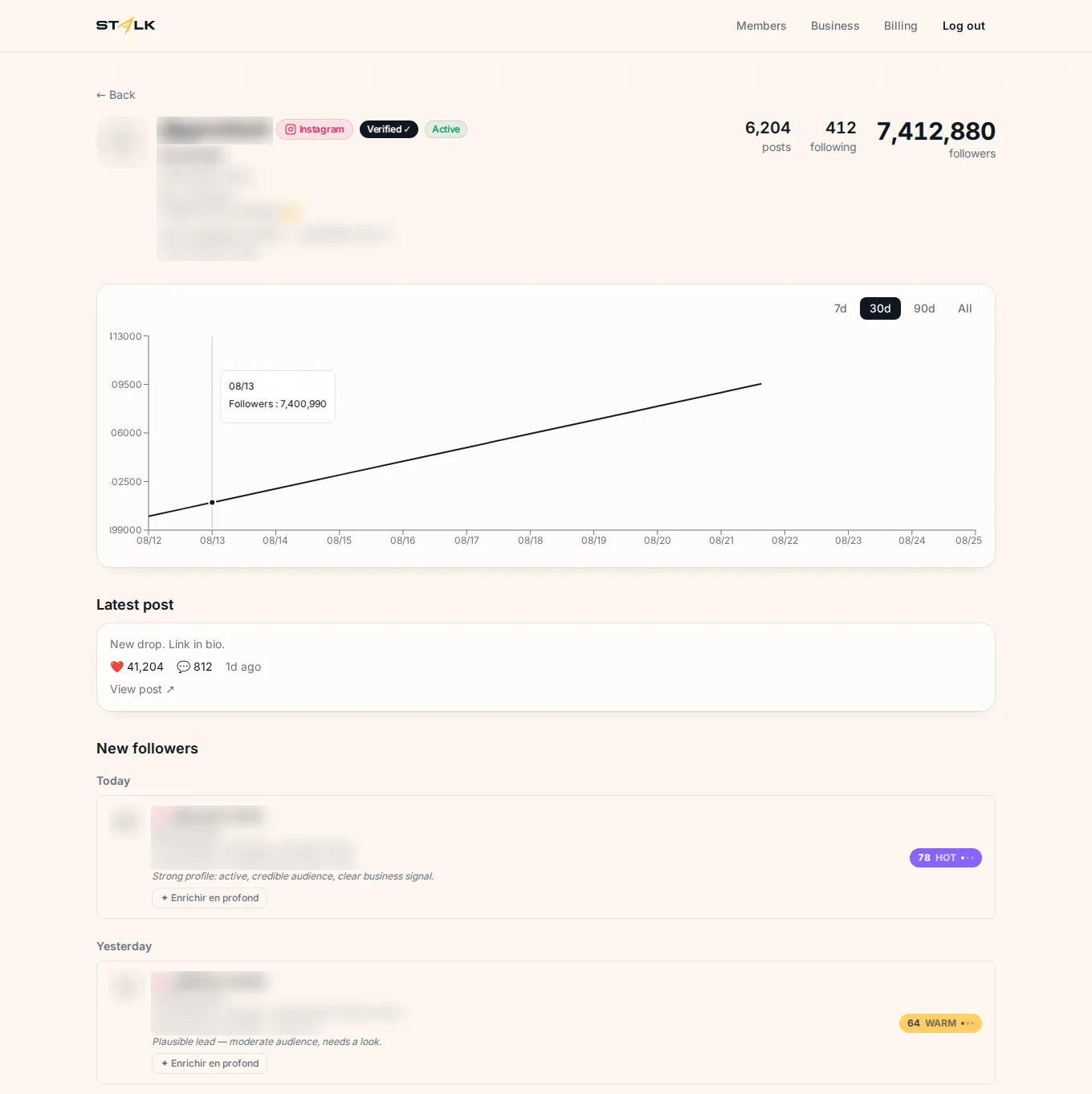
To see it on your own competitors, start a 7-day trial and add their profiles.
For the full method from competitor list to first message, read the guide on how to turn competitors' followers into leads. If most of your market lives on X, the X version of the playbook covers the platform's specifics.
Personal data and outreach rules
Names, bios and emails of new followers are personal data. Two texts matter before you contact anyone.
In the EU, Article 14 of the GDPR applies when you hold data you did not get from the person directly. You have to tell them who you are, why you process their data, and "from which source the personal data originate, and if applicable, whether it came from publicly accessible sources." If you use the data to contact them, that information is due "at the latest at the time of the first communication."
In the US, the FTC's CAN-SPAM compliance guide states that the law "makes no exception for business-to-business email." Every commercial email needs a clear way to opt out and your valid postal address, and you must honor an opt-out within 10 business days.
On the STALK side, anyone can remove themselves through the opt-out page, and people who opt out go on a permanent suppression list. The privacy policy explains how data-subject requests are handled. How you reach out, and whether it respects Instagram's and X's terms, is your responsibility. Write to people one at a time, and skip mass DMs and bought lists.
FAQ
How do you see who someone's newest followers are?
Neither Instagram nor X shows the date someone followed an account, so the followers list won't tell you who is new. Record the list, check it again later, and compare. A competitor new followers tracker automates that comparison.
Is there an app to see someone's new followers?
Yes, for public accounts. Follower trackers such as STALK take a baseline of a public Instagram or X profile, re-check it on a schedule and list the new arrivals. Count-only analytics apps show growth, but not names, and no tool can see the followers of a private account.
Is tracking a competitor's followers legal?
Looking at public profile information is something anyone on Instagram or X can do, and STALK works only from that public information. Storing that data and contacting people brings duties: in the EU, GDPR Article 14 requires you to tell them where you got it, at the latest when you first contact them, and in the US, CAN-SPAM rules apply to commercial email. Anyone can opt out of STALK at /opt-out.
Does Instagram notify someone when you track them?
STALK triggers no notification, because it doesn't interact with anyone's account. It doesn't follow, like or message anyone, and never logs in with your credentials. It reads public information, so neither the competitor nor their followers see any activity from you.
Where to start
Pick the competitors whose audience looks most like your buyers, check that their profiles are public, and let a baseline build. The first useful list comes from the second check onward. When you are ready to try it on your own market, start a 7-day trial.