To find leads from competitors' followers, pick the Instagram and X accounts your buyers already follow, watch who starts following them, qualify each new follower against your offer, and send a short first message about the problem they are trying to solve. The new followers matter most: someone who followed a rival this week is looking at your category right now, while someone who followed three years ago may have forgotten the account exists. You can run this method by hand with a spreadsheet, or use STALK, a competitor follower tracking tool, to do the watching and the qualifying for you.
Why competitor followers make good leads
A follow is a small, public act of interest. When someone follows a company that sells what you sell, they show they know the category exists and care enough to want updates. In cold outreach, most of your effort usually goes into finding people who even have the problem; here that filter is already applied.
The competitor audience also comes pre-segmented. Followers of a payroll tool for restaurants are mostly restaurant owners, managers and the people who advise them. Followers of a design agency's founder are mostly founders and marketers. You inherit the targeting work your competitor already paid for with content and ads.
A new follower is worth more than an old one
Exporting a whole followers list gives you thousands of names with no sense of timing. An old follower could be a former customer, an employee, or someone who followed during a giveaway years ago and never looked back.
A new follower is different. They clicked follow recently, which usually means something triggered them: a post, an ad, a search, a recommendation, a pain that got worse. Their interest is fresh and it is active. If you reach them while they are still comparing options, your message lands during the evaluation window. Months later, they may well have picked someone.
So the question to ask of each account is "who started following since I last looked?" The whole method below is built around it.
Step 1: Choose which accounts to watch
The accounts you watch decide the quality of every lead that follows. Start with a short list and grow it once you see which sources send good people.
Direct competitors
These are companies selling a similar product to a similar buyer. Their new followers are the closest thing you will get to people actively shopping. Pick the rivals your prospects mention on sales calls, the ones that show up next to you in comparisons, and the ones running ads in your niche.
If you sell to businesses, skip giant consumer brands whose followers are mostly fans.
Adjacent brands and niche creators
Adjacent brands sell something your buyer also needs, without competing with you. If you sell booking software to hair salons, a professional hair products brand or a salon furniture supplier attracts the same owners. Their audience is often less saturated with sales messages than your direct rivals' audience.
Niche creators work the same way. People who follow a consultant posting about restaurant margins have self-selected into a specific problem. Choose creators whose audience is mostly practitioners, and check a sample of their recent followers before committing.
Your own account
Add your own profile to the list. People who follow you have already raised a hand, yet most teams never look at them individually. A new follower of your brand who runs a business that fits your offer is the warmest lead in this entire guide, and the message you send them can be more direct because they came to you.
Step 2: Catch new followers as they arrive
Once you have your list, you need a way to see arrivals. Neither Instagram nor X shows the date someone followed an account, so any method works by comparing the follower list at two points in time. Whoever appears in the second snapshot and was absent from the first is new.
The manual way
On Instagram, anyone can open the followers list of a public account, and business profiles cannot be made private, so most brand accounts are open to this. A manual routine looks like this:
- Once or twice a week, open each competitor's followers list and note the profiles you have not seen before in a spreadsheet (handle, date you spotted them, which competitor).
- Open each new profile and fill in a few columns: business or personal account, website, what the bio says they do.
- Mark the ones that fit your offer and plan a message.
This costs nothing and works for two or three competitors. Past that, large accounts gain followers faster than you can read the list, and you lose track of who you already logged.
For a deeper comparison of the ways to track new followers, see our guide to a competitor new followers tracker.
Automating the watch with STALK
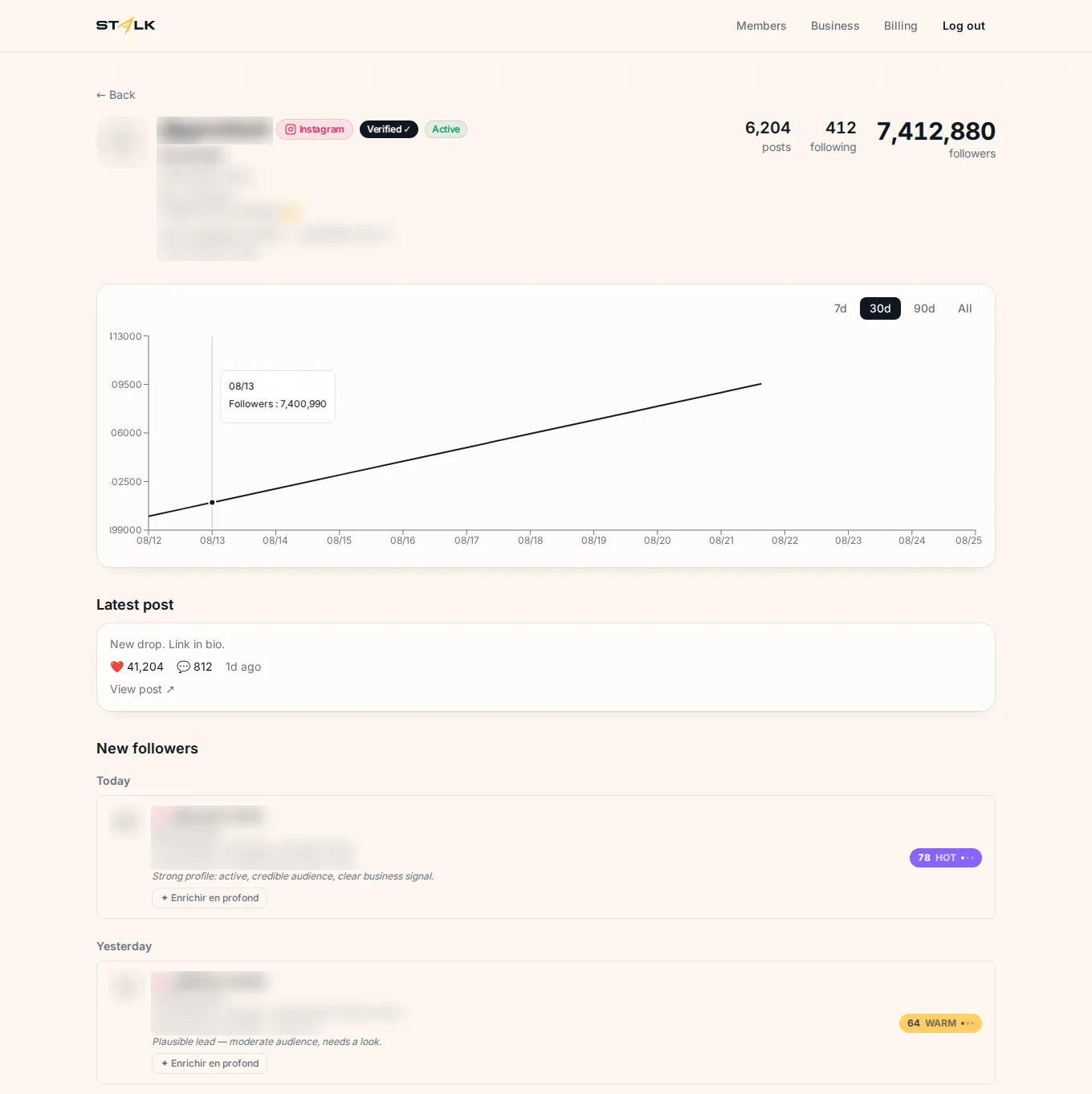
STALK automates the snapshot comparison. You paste the public Instagram or X profile of a competitor, and STALK takes a baseline snapshot of that audience. It then re-checks the account on a schedule. When the follower count moves, it pulls the new arrivals, drops anyone it has already seen, and keeps only people it has not logged before. You do not need access to the competitor's account, and STALK never asks for your own login: it works from public information only.
Because no platform exposes a follow date, STALK reports when a follower was seen between two checks. The more often an account is checked, the tighter that window. On X, STALK reads accounts through the official X API; we cover the X side in detail in how to turn X competitor followers into leads.
Step 3: Qualify before you reach out
A list of new followers is still a list of strangers. Sort them before you write anything, so you do not end up messaging bots or your competitors' employees. These are the signals worth checking on each profile:
| Signal | What it tells you |
|---|---|
| Business or creator account | They present themselves as a business, so a business conversation is less of a stretch |
| Website in bio | There is a company behind the profile, and a place to learn what they sell |
| Bio fit | Their role, industry or offer matches the buyer you serve |
| Reach | A tiny account may be too early for you; a very large one may already have a vendor or an agency |
| Follows several of your competitors | They are comparing options in your category |
You do not need a formal model: a "yes, maybe, no" column in your spreadsheet filters out most of the noise. Spend your writing time on the yeses.
People who follow several of your competitors
When the same person follows two or three of the rivals you track within a short period, they are very likely shopping.
If you track by hand, sort your spreadsheet by handle and look for duplicates across competitors. STALK does this automatically: when the same person follows several of the competitors you track, their score goes up on every card where they appear.
STALK scores leads in three stages. First, a free and instant pass on signals already known (business account, website, bio, reach, following several rivals). Only promising profiles get a second pass, where AI reads their profile against the business you described. Only the best of those trigger deep web research on their website and linked pages, which is where an email usually turns up. Each lead ends with a score from 0 to 100 and a readable reason, and weak leads never cost you an email credit.
Step 4: Write the first message
The person you found has shown interest in a category. Your message should connect to that interest without making them feel observed.
What to reference
Talk about the problem their profile suggests they have, or about something they published. Good openers draw on public, relevant context:
- Something in their bio ("You run two studios in Austin, so scheduling across locations is probably a weekly headache").
- A recent post or product launch of theirs.
- A question tied to the category ("Are you still choosing a booking tool, or already set up?").
Keep it short, ask one question, and make it easy to say no. Offer something useful on its own, like a relevant guide, a quick audit or a straight answer to a question they are likely asking. If you work from email, the address should come from their own public website, the way STALK finds it.
What to avoid
Never open with "I saw you just followed [competitor]." It feels like surveillance, and it turns your first impression into a comparison with a rival, on the rival's terms. Talk about their problem and leave the follow out of it.
Do not send the same message to everyone. X's automation rules state that "you may not send unsolicited Direct Messages in a bulk or automated manner." Write each first message yourself, and cap how many you send per day so each one gets real attention.
If someone does not reply, one polite follow-up is plenty. If they ask you to stop, stop, and remove them from your list.
Instagram and X: what changes
On Instagram, many small businesses run their shop, studio or agency from a business account with a website link in the bio. That makes qualification fast: the profile tells you what they sell. Instagram Direct is where many owners already talk to customers, so a relevant, personal DM can feel natural there, as long as it reads like a person wrote it. For a broader view of the channel, including methods that do not start from competitors, see our overview of Instagram lead generation.
On X, profiles tend to be thinner. Many people post under a personal handle with a short bio, so the useful signals often sit in what they post. Twitter competitor followers are worth watching when your buyers are active there, and replying to one of their posts is a softer way to start a conversation than a cold DM.
Keep one spreadsheet or one tool for both platforms, so a person who follows your rivals on Instagram and on X shows up once.
Personal data and compliance
Competitor followers are real people, and once you log their handles, score them and contact them, you are processing personal data. A few rules apply no matter which method you use.
In the EU and UK, when you collect data about someone from a source other than that person, Article 14 of the GDPR requires you to tell them, at the latest in your first message, who you are, why you have their data, where it came from and what their rights are. Article 21 gives people the right to object to direct marketing at any time, and once they object you can no longer use their data for it. In practice: say who you are, keep the message relevant to their business, and make opting out easy.
In the US, commercial email falls under the CAN-SPAM Act. The FTC's compliance guide notes that "the law makes no exception for business-to-business email," and requires a valid physical postal address, a clear way to opt out, and opt-outs honored within 10 business days.
On STALK's side, emails come from public sources only (the lead's own site and linked pages) and are revealed on demand. Anyone can remove themselves through the one-click opt-out page, which adds them to a permanent suppression list, and data-subject requests are handled as described in our privacy policy. How you reach out remains your responsibility, so the rules above apply to every message you send.
A weekly routine
A simple rhythm keeps the method running week after week:
- Monday: review new followers from the past week across your tracked accounts. Archive the obvious misfits.
- Monday, next hour: qualify the rest with the table above. Flag anyone who follows several competitors.
- Tuesday to Thursday: write first messages to your best leads, a handful per day, each one personal.
- Friday: send single follow-ups to last week's non-responders, and note which competitor accounts produced the leads that answered.
- Once a month: drop the accounts that send poor leads and test a new adjacent brand or creator in their place.
After a month or two, you will know which accounts send buyers and which send noise.
If you want the watching and scoring handled for you, STALK's Solo plan (€149 per month) covers five tracked competitors with scans every six hours, and the Pro plan (€299) adds hourly scans and AI scoring across ten. You can start a 7-day trial for €19, with no auto-renewal.
FAQ
Is it legal to contact a competitor's followers?
Following a public account is public information, and contacting someone about your business is generally allowed, but data protection and anti-spam rules still apply. In the EU, you must tell people where you got their data and let them object to direct marketing, and in the US, commercial emails must follow CAN-SPAM. Platform rules also matter: X forbids unsolicited DMs sent in bulk or by automation.
Can you see who recently followed an Instagram account?
Instagram does not show the date someone followed an account. You can open the followers list of any public account, but the only reliable way to know who is new is to compare the list at two points in time. You can do this by hand in a spreadsheet, or use a tool that re-checks the account on a schedule and flags new arrivals.
Do I need access to the competitor's account?
No. On Instagram, anyone can see who follows a public account without any access to it. STALK works from public information only, on Instagram and X, and never asks for the competitor's login or yours.
Is there a free way to find leads from competitors' followers?
Yes. Open each competitor's followers list once or twice a week, log new profiles in a spreadsheet, and qualify them by hand using their bio, website and account type. It works for a few accounts, after which the volume makes it hard to keep track of who you have already seen.