Instagram lead generation comes down to six methods: content that sends people to a lead magnet, Meta's paid lead ads, DM conversations started by the prospect, creator collaborations, watching your competitors' new followers, and follower export tools. Each one trades money, time and risk differently, and each produces a different kind of lead. Below: how each method works, what Meta allows, what it costs, and a comparison table.
What counts as a lead on Instagram
A lead is a person or business you can identify, who shows some interest in what you sell, and whom you can reach through a channel they accepted or can reasonably expect. On Instagram, that means someone who filled out a form, sent you a DM, left an email on your site, or a profile you identified as a fit and can contact through a public business channel.
Method 1: content and profile optimization
This is the slow, free method, and the base for everything else: your profile is the landing page every other method sends people to.
What to fix first:
- A bio that names your customer and the outcome, in plain words.
- A single, clear link in bio that goes to one offer, or to a short page with two or three options at most.
- Highlights that answer buyer questions: pricing logic, case examples, how to start.
- Posts and reels built around problems your buyers search for, with a direct call to action at the end ("comment GUIDE", "DM me AUDIT", "link in bio").
Link in bio and lead magnets
A lead magnet is the reason someone gives you an email: a checklist, a template, a short audit. Show the problem in a reel, then send people to the full resource behind the link.
Effort: high and continuous. Cost: your time, or a content budget. Lead type: inbound, self-selected, usually early in the buying process. Main risk: months of posting before the volume is useful.
If you want to go further on free approaches, read how to find leads on Instagram without ads.
Method 2: Instagram lead ads and instant forms
Lead ads are Meta's native, paid option. According to Meta's documentation on lead ads, they can appear in Instagram Feed and Stories and come in three types: lead ads with calling, lead ads with an instant form, and lead ads that click to message. With an instant form, people fill out the form without leaving Instagram, and you download the results from Ads Manager or Leads Center in Meta Business Suite, or connect a CRM system.
Instant forms accept custom questions, so you can qualify before you talk to the lead: company size, budget range, timeline. The easier the form, the more contacts you get and the weaker their intent, so one or two qualifying questions are worth the lost volume.
A leads campaign can also send people into an Instagram Direct conversation, where Meta's "Automated chat" template asks qualifying questions, then contact questions.
Effort: medium (creative, targeting, follow-up). Cost: ad spend, which depends on your budget, audience and offer. Lead type: inbound, with contact details, intent varies with the offer. Main risk: paying for volume that your sales team cannot qualify fast enough.
Method 3: DM conversations and keyword-triggered replies
Many Instagram sales close in the DMs, and for anything automated, Meta's rules decide who can start the conversation.
What Meta allows for automated messages
Meta's developer documentation for Instagram messaging states that an app can message an Instagram user only after that user has messaged the business account, and that the business has 24 hours to respond. A human agent tag extends that window when a person handles the reply.
The comment-to-DM pattern ("comment GUIDE and I'll send it") runs on a separate feature called private replies. Per Meta's private replies documentation, you can send one message to the commenter, within 7 days of the comment. Follow-ups are allowed only if the person responds, and must go out within 24 hours of that response. The reply lands in their inbox if they follow you, or in their message requests if they don't.
In practice, Instagram lead generation automation that stays inside the rules looks like this:
- A post or reel asks people to comment a keyword.
- An automated private reply sends the resource and one qualifying question.
- If the person answers, the automated flow or a human continues the conversation inside the 24-hour window.
- Qualified conversations get handed to a salesperson.
Avoid sending unsolicited DMs at scale, by hand or with a tool that controls your login. Meta's official messaging interface does not let a business start the conversation, so tools that do are working outside Meta's rules, with your account on the line.
Effort: medium to high (someone has to answer). Cost: time, plus a CRM inbox tool if volume grows. Lead type: warm, conversational, easy to qualify. Main risk: slow replies, which cool a lead that was ready to talk.
Method 4: creator collaborations
Creators give you access to an audience that already trusts them. For lead generation, pick formats that send people to a specific action, such as a co-hosted live with a sign-up link or a collab post with a keyword to comment.
If the creator is paid or gets something in return, the Instagram Terms of Use require branded content to follow Meta's Branded Content Policies, which means using the branded content tool. Give each creator a separate link or keyword so you know which partnership produced the leads.
Effort: medium (sourcing, briefing, negotiating). Cost: creator fees or product, plus your time. Lead type: inbound, borrowed trust, quality depends on how close the creator's audience is to your buyer. Main risk: paying for reach that doesn't match your customer.
Method 5: watching your competitors' new followers
When someone follows a competitor, they are telling you they care about the problem you solve, right now, and they are often comparing options.
You can do it by hand: open your closest competitors' follower lists regularly and note the new faces that look like buyers. It gets hard to keep up quickly, because Instagram does not show the date someone followed an account and you end up re-reading the same list.
STALK, a competitor follower tracking tool, automates that part. It takes a baseline snapshot of each competitor's audience, re-checks it on a schedule, and when the follower count moves, it pulls the new arrivals, drops anyone it has already seen, and keeps only people it hasn't logged before. The detection time is "seen between two checks", since neither Instagram nor X exposes the exact follow date. You don't need access to the competitor's account, and STALK never asks for your own login: it works from public information only.
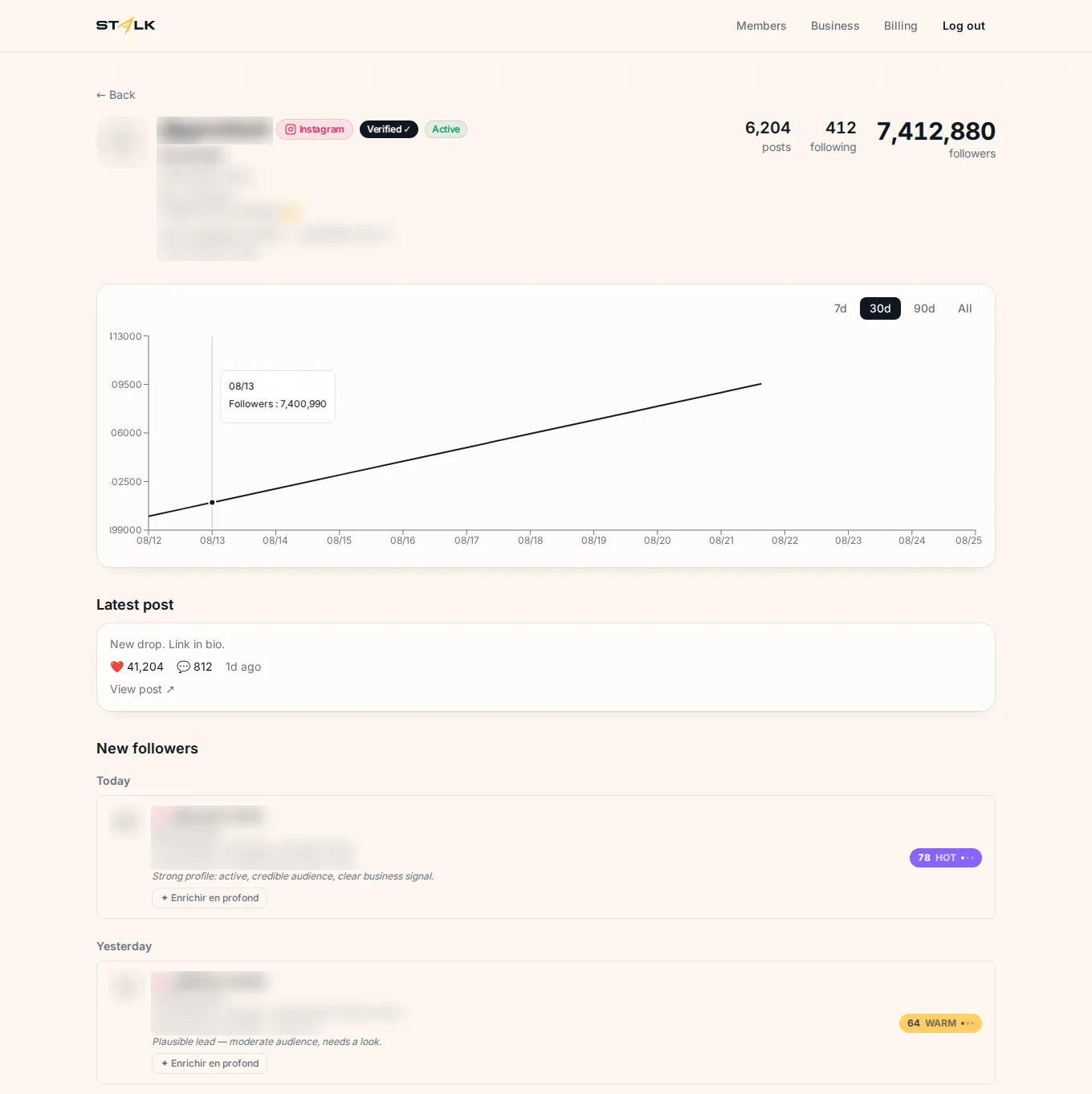
Scoring is where AI lead generation on Instagram helps. STALK scores each new follower from 0 to 100 in three stages. A free, instant pass looks at signals already known: business account, website, bio, reach. Only promising profiles get an AI pass that reads their profile against the business you described. Only the best of those trigger deep web research on their website and linked pages, which is where an email can turn up. Each score comes with a readable reason, and weak leads never cost an email credit. When the same person follows several competitors, the score goes up on every card where they appear, because that pattern usually means they're shopping.
For the full method, read how to turn competitors' followers into leads. To compare tracking approaches, see the competitor new followers tracker guide.
Effort: low once set up, then daily review of the best-scored leads. Cost: a subscription; STALK plans start at €149 per month for 5 tracked competitors. Lead type: outbound, but timed on a real signal of interest. Main risk: reaching out clumsily. The person did not ask to hear from you, so your first message has to be relevant, short and easy to decline.
If you want to test this method on your own competitors, you can start a 7-day trial.
Method 6: follower and email export tools
Follower export tools promise a spreadsheet of every follower of any account, sometimes with emails attached. They look like the fastest route and carry the most risk.
Why they put your account at risk
Some export tools ask you to connect your own Instagram account and run the extraction through it. The account you use to sell then carries the risk of any restriction, and handing your login to a third party is a security problem on its own.
Quality is the other problem. A bulk export mixes old followers, inactive accounts and people unrelated to your offer, with no sign of when or why they followed, so the time you saved goes into filtering.
Buying ready-made lists of Instagram users is worse: the people on the list never had any contact with you, and you cannot tell where their data came from, which makes the GDPR duty to tell them the source impossible to meet.
Effort: low. Cost: varies, often low. Lead type: cold, bulk, unqualified. Main risk: your login in someone else's hands, and personal data of unknown origin.
Instagram lead generation methods compared
| Method | Cost | Effort | Lead type | Speed | Main risk |
|---|---|---|---|---|---|
| Content and profile | Time | High, continuous | Inbound, early stage | Slow (months) | Low volume for a long time |
| Lead ads and instant forms | Ad spend | Medium | Inbound, with contact details | Fast (days) | Paying for weak intent |
| DM conversations and keyword replies | Time, inbox tool | Medium to high | Warm, conversational | Fast once content runs | Slow replies |
| Creator collaborations | Fees or product | Medium | Inbound, borrowed trust | Medium | Audience mismatch |
| Competitor new followers | Subscription | Low after setup | Outbound, timed on interest | Fast (hours to days) | Clumsy outreach |
| Follower export tools | Low | Low | Cold, bulk | Instant | Login at risk, data of unknown origin |
How to pick an Instagram lead generation strategy
No single method covers every stage. Combine two or three based on your budget, your sales cycle and your team's time.
If you have more time than budget
Start with methods 1 and 3: fix your profile, publish content that invites a keyword comment, and answer every DM quickly. Add competitor watching once you know which accounts your buyers follow, since it feeds your outreach without waiting for your own audience to grow.
If you have budget and need volume
Run lead ads with instant forms or an automated chat, with qualifying questions. Make sure someone follows up within the day, because a lead who filled a form and heard nothing loses interest fast.
If you sell B2B or high-ticket
Timing and fit matter more than volume. Competitor watching and DM conversations fit best here: find businesses showing interest in your category, score them, and start a relevant, personal conversation.
Where AI fits
AI is useful for sorting leads, and less useful for talking to them. Scoring profiles against your offer, summarizing why a lead looks promising, and deciding who deserves research time are good uses. Writing hundreds of generic DMs is a poor use, and it breaks the rules above anyway. When you compare any Instagram lead generation tool, ask what it does with your account login, where its data comes from, and how people can opt out.
Personal data and outreach rules
Every method except the inbound ones involves processing personal data of people who did not give it to you directly. In the EU and UK, GDPR Article 14 requires you to inform them, at the latest at your first communication, including where their data came from. Article 21 gives them the right to object to direct marketing at any time, and once they object you must stop. In the US, the FTC's CAN-SPAM rules apply to all commercial email, including business-to-business: your email needs a valid postal address and a clear opt-out, and you must honor opt-outs within 10 business days.
STALK only collects emails from public sources (the lead's own website and linked pages), reveals them on demand, and keeps a permanent suppression list for anyone who opts out at /opt-out. The details are in our privacy policy. How you reach out remains your responsibility, so keep your messages relevant, identify yourself, and make opting out easy.
FAQ
How do you do lead generation on Instagram?
Optimize your profile so it says who you help and where to click, then combine methods. Inbound options are content with a lead magnet, lead ads with instant forms, and DM conversations triggered by comments. Outbound means identifying people who show interest in your category, such as new followers of your competitors, and contacting them with a relevant message.
What is the best Instagram lead generation tool?
It depends on the method you rely on. For paid forms, Meta's own Ads Manager and Leads Center are enough. For DM volume, a CRM inbox tool that uses Meta's official messaging features helps your team answer within the 24-hour window. For outbound, a competitor follower tracking tool with lead scoring saves the manual review. Avoid tools that ask for your Instagram login to export followers.
Can you get leads on Instagram for free?
Yes, with time. Profile optimization, content with a lead magnet, answering keyword comments by DM, and manually checking your competitors' followers cost nothing but effort. The limit is volume and consistency: free methods are slow to build and hard to keep up by hand.
Is it legal to email people you found on Instagram?
It depends on where they are and how you do it. In the EU and UK, GDPR requires you to tell them where you got their data at the latest in your first message, and to stop if they object to direct marketing. In the US, CAN-SPAM requires a postal address and a working opt-out in every commercial email, including B2B. Only use emails the person published themselves, and never buy lists.
Where to start
Pick the method that matches what you have today: time, budget, or a clear list of competitors your buyers follow. Run it for a few weeks, measure which leads turn into conversations, and add a second method once the first one works. If competitor watching is the piece you're missing, start a 7-day trial and add the accounts your buyers already follow.