To turn Twitter competitor followers into leads, pick the X accounts your buyers follow, check who starts following them, qualify each new profile from its bio, link and posts, then open a conversation with a public reply, a personal DM or an email to the address on their website. X shows who follows a public account, but never when they followed. You can run the method by hand, or let STALK, a competitor follower tracking tool, watch the accounts and score the arrivals for you.
Why X competitor followers are worth tracking
People follow accounts on X to get their posts in the feed, so when an account sells software to accountants, its followers are telling you what they work on.
The new ones matter most. An old follower of a rival may be a customer, a former employee or someone who stopped reading years ago. A person who followed this week is more likely to be comparing options now. The pillar guide on turning competitors' followers into leads builds the whole method around that question: who is new since the last check?
Which X accounts to watch
Start with five to ten accounts and replace the ones that send poor leads after a few weeks.
Company accounts and the people behind them
On X, many founders post under their own name, and their personal account can draw a different crowd than the brand account. Watch the competitor's company handle and its founder's handle, and add a product or growth lead if they post about the product. Skip employee accounts that mostly post about their personal life: their followers are friends and former colleagues.
Category voices, podcasts and event accounts
Some of the best sources on X sell nothing that competes with you: an analyst who covers your market, a podcast your buyers listen to, a conference in your niche. Their new followers have raised a hand for the topic. Before adding one, read twenty profiles from its followers list. Keep it if most are practitioners in your market.
Your own followers
Add your own account. A new follower who fits your offer came to you, so you can write to them more directly.
How to see who is new on X (Twitter)
What X shows you, and what it doesn't
X shows the followers list of any public account in the app. It does not show the date of each follow, and there is no filter for "followed this week."
The official API has the same gap. The followers endpoint of the X API returns pages of up to 1,000 user profiles. The only date on each profile is the account's creation time, and nothing records when the follow happened. So the only way to find new followers is to compare the list at two points in time: anyone present now and absent from the previous check is new.
The creation date still helps. An account created last week, with no bio and no posts, that follows five of your rivals at once is more likely a bot than a buyer.
Checking by hand
For two or three accounts, a weekly routine works. Open each followers list on X, log every handle you have not seen before in a spreadsheet (with the date and the account it followed), then open each profile to qualify it. It breaks down on large accounts, which gain followers faster than you can read. For the ways to do this at scale, see our guide to a competitor new followers tracker.
Tracking competitor Twitter followers with STALK
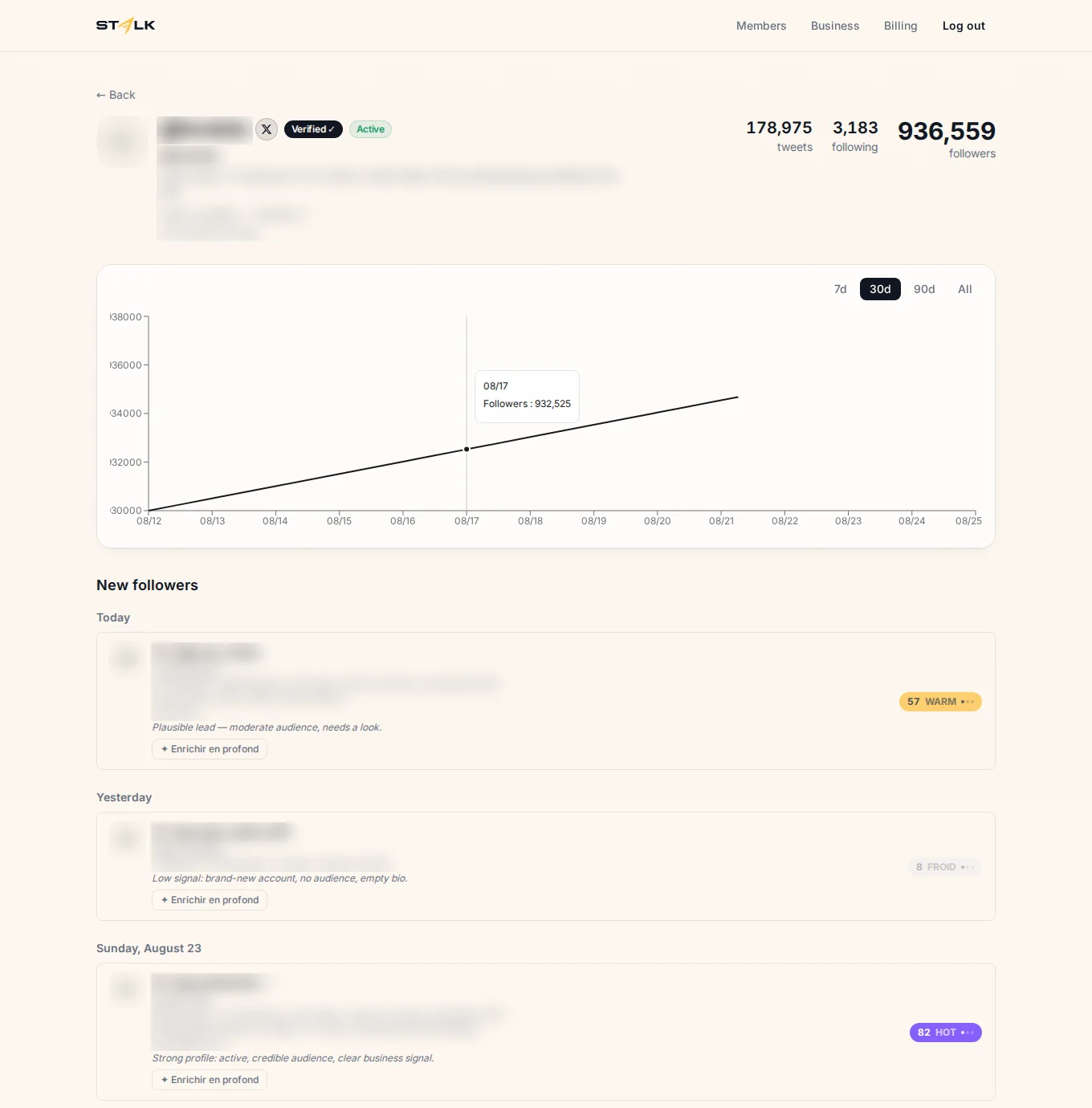
To automate the comparison, you paste the public X profile of a competitor, and STALK takes a baseline snapshot of its audience, then re-checks the account on a schedule. When the follower count moves, it pulls the new arrivals, drops anyone it has already seen and keeps only people it has not logged before. You need no access to the competitor's account, and STALK never asks for your own login.
STALK reads X accounts through the official X API and shows the new followers it detects between two checks. Detection works from what the API returns, so on a very large account that gains followers quickly, STALK cannot promise to catch every single arrival.
How to qualify an X profile
X profiles are shorter than Instagram business profiles, so more of the signal sits in what people post. Check these on each new follower:
| Signal | Where to look | What it tells you |
|---|---|---|
| Role | Bio | Titles and "building [product]" lines show who decides |
| Link | Website field or bio | A company behind the handle, and a place to find an email |
| Location | Location field | Whether they are in a market you serve |
| Join date | Profile header | Very new, empty accounts are often bots |
| Recent posts | Timeline | What they work on this month, and a topic for a reply |
| Follows several rivals | Your log | They are comparing options in your category |
STALK scores each new follower in three stages: a free, instant pass on signals it already has (business account, website, bio, reach, several rivals followed), then an AI pass on promising profiles that reads them against the business you described, then deep web research on the best ones, which is where an email turns up. Each lead gets a score from 0 to 100 with a readable reason, and weak leads never cost an email credit. When the same person follows several of your tracked competitors, the score goes up on every card where they appear.
How to reach out on X
Reply before you DM
X runs on public conversation, which gives you a soft first step. Find a recent post where the person asks a question or describes a problem, and reply with a useful answer. Leave your product out of it. If the exchange goes well, a DM later reads as a continuation.
Never open with "I saw you just followed [competitor]." It makes people feel watched and frames your first message as a comparison on your rival's terms.
When a DM makes sense
A DM fits when you already have a thread to refer to, or when their bio invites contact. Whether you can message someone depends on their settings, so some profiles will stay out of reach there.
Write each DM yourself. X's automation rules state that "you may not send unsolicited Direct Messages in a bulk or automated manner, and should be thoughtful about the frequency with which you contact users via Direct Message." Refer to something they posted, ask one question and make it easy to say no.
Email from their website
Many X profiles link to a company site that lists a contact address. Email reaches people who rarely check DMs. In STALK, emails come from public sources only (the lead's own site and linked pages) and are revealed on demand, counted against your monthly quota.
X ads vs. named leads
A paid campaign on X reaches an audience you define in X Ads. The campaign reports impressions and clicks, and the people behind them stay anonymous. Tracking new followers gives you the reverse: a short list of named profiles you can read, qualify and talk to one at a time. The two can run side by side, the ad for reach and the follower list for conversations.
Personal data and the rules
Once you log handles, score profiles and contact people, you process personal data.
In the EU and UK, when you get someone's data from a source other than them, Article 14 of the GDPR requires you to tell them who you are, why you have their data, where it came from and what their rights are, at the latest in your first message. Under Article 21, people can object to direct marketing at any time, and their data can then no longer be used for it. In the US, the FTC's CAN-SPAM compliance guide says "the law makes no exception for business-to-business email," and requires a valid physical postal address, a clear opt-out and opt-outs honored within 10 business days.
On STALK's side, anyone can remove themselves through the one-click opt-out page, which puts them on a permanent suppression list, and data-subject requests are handled as described in our privacy policy. How you reach out stays your responsibility.
A weekly X routine
- Monday: review last week's new followers and archive bots, job seekers and your competitors' staff.
- Monday, next hour: qualify the rest with the table above and flag anyone following several rivals.
- Tuesday to Thursday: reply to your best leads' recent posts, then DM or email where a conversation exists.
- Friday: send one follow-up to last week's silent leads and note which watched accounts produced the people who answered.
- Once a month: swap the weakest source account for a new founder, podcast or category voice.
After a month you will know which X accounts send buyers. If you want the watching and scoring handled for you, you can start a 7-day trial of STALK for €19, with no auto-renewal.
FAQ
Can you target a competitor's followers with X ads?
X Ads sets targeting at campaign setup, and the available options change over time, so check them in your ads account. An ad audience stays anonymous either way. For named profiles you can qualify and contact, track the competitor's new followers.
Can you see when someone followed an account on X?
No. The X app does not show follow dates, and the official API returns follower profiles whose only date is the account's creation time. To know who is new, compare the followers list at two points in time, by hand or with a tool that re-checks the account on a schedule.
Is it allowed to DM people who follow a competitor?
Writing to someone about your business is generally allowed, but X forbids unsolicited DMs sent in bulk or by automation. Write each message yourself. Data protection and anti-spam laws such as the GDPR and CAN-SPAM also apply to your outreach.
Do you need access to the competitor's X account?
No. Follower lists of public X accounts are visible without any access. STALK works from public information only and never asks for the competitor's login or yours.